
 Amazon
 eBay
eBay
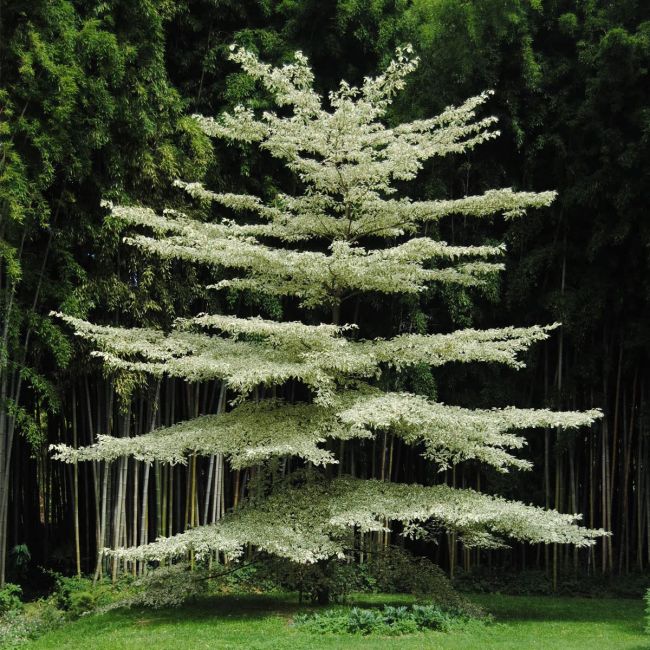


Cornus controversa Variegata - Stock Clearance - Grafted Plant in 3 L Pot
Please Note: These plants are some we inherited from the previous occupiers of this site. They are healthy plants but they were not trained as trees. They are a real bargain. You can either let them grow as a shrub, some will eventually form themselves into trees, or you can pick a central leader and train it upwards on a cane. The two images in the wooden photo booth are from the current batch.
Originating from the Eastern Himalayas, China, Japan and Taiwan his wonderful small, slow growing tree, was introduced into the Uk around 1890. To my mind one of the most beautiful of all small garden trees and an RHS Award of Garden Merit winner. As its common name suggests, it has strictly tiered branches that from spring to autumn are wreathed in stunning creamy margined leaves. Flowers are produced in abundance in early summer and are formed in white upturned clusters along the tops of the branches. In autumn the leaves turn to hues of red orange and purple. Perhaps not as good as the green leaved variety, but still a pleasure to behold! A truly beautiful spectacle in any garden! To emphasis the tiered effect it is a good idea to prune out the twiggy growths that can form between the branches. Its slow to medium growth rate and compact habit make it ideal for the smaller garden where it likes a full sun location in fertile, water retentive soil. This tree is often grown in a pot or container. Use a good quality compost. Ensure you feed regularly as a hungry plant is a poor performer. We recommend Osmoscote pro 8-9 month applied in the early spring. One application gives all the nutrients the plant requires for the whole year. John Innes is a soils based compost. These are grafted plants.